 ONARC
ONARC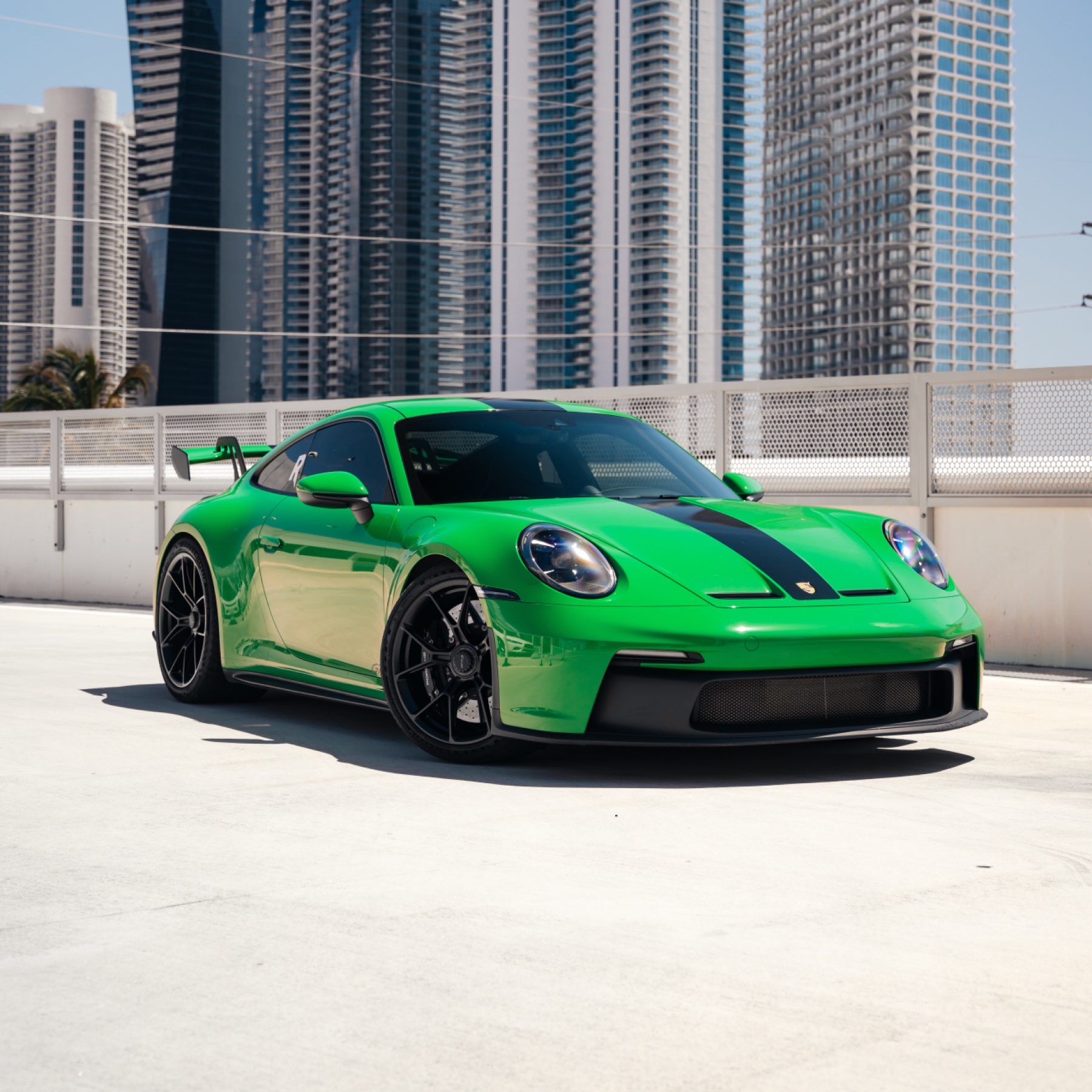
The short version: The Porsche 911 GT3 rents for $1,095 per day at Monarc VIP. You get a 4.0-liter naturally aspirated flat-six that screams to 9,000 RPM, 502 horsepower sent to the rear wheels through one of the sharpest PDK transmissions ever built, and a chassis that was developed on the Nurburgring Nordschleife. In an era where every performance car has a turbocharger strapped to it, the GT3 is a mechanical holdout -- an engine that makes its power through displacement and revolutions, not forced induction. This is not the car you rent because you want a crowd on Ocean Drive. This is the car you rent because you want to DRIVE.
I have managed this fleet for years. I have handed over the keys to every car we own hundreds of times. The GT3 is the car that tells me the most about who is renting it. Nobody rents a GT3 by accident. Nobody picks it because they saw it on Instagram. They pick it because they know what a naturally aspirated flat-six sounds like at 8,500 RPM and they want that sound in their life for a day. This review is for those people.
First Impressions: The GT3 Up Close
The 911 GT3 does not announce itself the way a Lamborghini does. There is no scissor door, no twelve-inch ground clearance drop, no neon paint job demanding your attention from three blocks away. The GT3 is more surgical than that. You walk up to it and the first thing that registers is the rear wing. Not a decorative spoiler. A proper, swan-neck-mounted, track-derived rear wing that sits high enough above the engine lid to actually work. It is functional downforce hardware bolted to a street car, and it immediately tells you this machine has a different set of priorities than anything else in the parking lot.
Walk around to the front and you see the stance. The GT3 sits lower than a standard 911 by about 25 millimeters, and the front track is wider. The front fenders have subtle vents -- not cosmetic, they actually extract air from the wheel wells to reduce aerodynamic lift. The front splitter is deep and aggressive but not cartoonish. Everything about the exterior says "I was designed in a wind tunnel and validated on a racetrack" without screaming it. It is the difference between a tailored suit and a costume. Both get attention. Only one earns respect from people who know what they are looking at.
Open the door -- a normal door, which swings out like a normal car, because Porsche does not need theatrical hinges to make a statement -- and the interior continues the theme. The seats are carbon fiber-backed buckets. The steering wheel is small-diameter, leather-wrapped, with a yellow twelve o'clock marker. The center console has been stripped down. The rear seats have been deleted. The carpeting is thinner than a standard 911. Porsche did not add things to make this car special. They removed things. Weight is the enemy, and the GT3's entire interior philosophy is "if it does not help you drive faster, it does not belong here."
And then you see the tachometer. Right there in the center of the instrument cluster, an analog needle sweeping a dial that goes all the way to 10,000 RPM, with the redline starting at 9,000. That tachometer is a promise. Every other car in our fleet redlines between 6,500 and 8,500. The GT3 has an extra thousand RPM of usable range that no turbocharged engine can touch. That is where the magic lives.
Behind the Wheel: How the GT3 Actually Drives
I am going to tell you something that car reviewers dance around but rarely say directly: the Porsche 911 GT3 has the best steering feel of any car you can rent in Miami. Not the quickest steering. Not the most aggressive. The best feel. The hydraulic-feel electric power steering communicates every texture of the road surface through the rim with a fidelity that the McLaren, the Ferrari, and the Lamborghini cannot match. You feel expansion joints. You feel the transition from fresh asphalt to patched pavement. You feel the front tires loading up as you turn in to a corner, and you feel them approaching the limit of grip with a gradual, progressive buildup that gives you confidence rather than anxiety. This steering is the reason the GT3 exists.
The 4.0-liter flat-six sits behind the rear axle, where every 911 engine has sat since 1963. But this is not a standard 911 engine. This is derived from the 911 GT3 Cup race car's powerplant -- a naturally aspirated unit with individual throttle bodies, titanium connecting rods, and a dry-sump oiling system that keeps oil flowing under sustained lateral G-forces on a racetrack. It makes 502 horsepower at 8,400 RPM. Not at 3,500 RPM where a turbo engine peaks. At 8,400 RPM. That means you have to work for the power. You have to rev the engine. And that is the entire point.
From idle to about 4,000 RPM, the GT3 feels brisk. Quick. Clearly fast, but not violently so. You could commute in it at these revs. And then you pass 5,000 RPM and the engine tone changes. The flat-six wail that was humming behind your head sharpens into something rawer and more insistent. At 6,000 RPM the intake noise becomes prominent -- a mechanical howl that sounds like the engine is breathing through a megaphone. At 7,000 RPM you are deep into the powerband and the acceleration is genuinely fierce, pinning you back into the carbon bucket seat. At 8,000 RPM the sound is indescribable through text. It is a shrieking, metallic, high-frequency scream that no turbo engine on Earth can produce because turbochargers physically muffle the intake sound that makes naturally aspirated engines sound alive.
And then the tach sweeps past 8,500 and you still have five hundred RPM to go. The last 500 RPM before the 9,000 redline is where the GT3 transcends being a car and becomes an experience. The sound is so visceral, so raw, so mechanically present that you forget you are on a public road in Miami. For a few seconds, every time, you are on a racetrack. The PDK fires off an upshift in milliseconds, the revs drop to 6,500, and you do it all over again in the next gear. It is addictive in a way that no turbo car can replicate, because the reward is proportional to how hard you work for it.
The PDK: A Weapon Disguised as a Gearbox
The 7-speed PDK dual-clutch transmission is Porsche's masterpiece. I have driven every dual-clutch and automated manual in the fleet -- the McLaren's SSG, the Huracan's LDF, the Ferrari's F1 box -- and the PDK is the one that feels the most like an extension of your intentions. Upshifts in Sport Plus mode happen so fast that they register as a bark from the exhaust before your brain processes that a gear change occurred. Downshifts blip the throttle with a mechanical precision that sounds like the engine is clearing its throat. In manual mode with the paddles, the PDK holds every gear exactly where you leave it, right to the 9,000 RPM fuel cut, no automated upshifts, no nanny intervention. It trusts you. That trust is rare in modern performance cars.
In Normal mode, the PDK is perfectly civilized. Smooth, quiet shifts. Early upshifts for fuel economy. No drama. The GT3 can cruise on the highway at 2,000 RPM in seventh gear like a luxury sedan. The duality is what makes it remarkable -- the same gearbox that fires off sub-200-millisecond shifts at redline will also putter through South Beach traffic without a complaint.
The Chassis: Race-Derived and You Can Feel It
The GT3 uses a double-wishbone front suspension -- the same geometry found on the 911 RSR race car. Every other 911, including the Carrera S, uses MacPherson struts. The double-wishbone setup gives the front end a precision and consistency that is immediately noticeable. Turn-in is instant and linear. There is no dead zone in the steering, no moment of uncertainty where you are waiting for the front tires to respond. You point the car and it goes. The rear end, with its engine hanging behind the axle, rotates around the front wheels with a fluidity that makes the car feel smaller and lighter than its spec sheet suggests.
The ride is firm. I will not pretend otherwise. This is not a McLaren 720S with its hydraulic suspension magic that can mimic a luxury car on demand. The GT3's dampers are set up for track use with street compliance, not the other way around. You feel the road. You feel Miami's less-than-perfect pavement. But you also feel everything the car is doing, and that information is what makes it so rewarding to drive. Every bump, every surface change, every weight transfer -- the GT3 tells you all of it, all the time. Some drivers find that exhausting. The kind of driver who rents a GT3 finds it intoxicating.
Ready to hear 9,000 RPM for yourself? The Porsche 911 GT3 is available for date-specific quote review with delivery planning when selected.
Book the Porsche 911 GT3The Naturally Aspirated Argument: An Endangered Species
Here is the uncomfortable truth that every car enthusiast already knows: naturally aspirated high-performance engines are going away. Porsche turbocharged the standard 911 in 2016. Ferrari went turbo on the 488 in 2015. McLaren has been turbo since the MP4-12C. Mercedes-AMG, BMW M, Audi RS -- all turbo. The number of performance cars you can buy new with a naturally aspirated engine that revs past 8,000 RPM can be counted on one hand. The GT3 is one of them.
In our fleet, only two cars offer naturally aspirated engines: the GT3 and the Lamborghini Huracan EVO with its 5.2-liter V10. Both are endangered species. The Huracan's successor, the Temerario, has gone to a twin-turbo V8. Porsche has confirmed the GT3 will survive in the next generation 911, but for how long? Regulations, emissions targets, and electrification are closing the window on engines like these. Renting the GT3 today is not just driving a great car. It is experiencing a type of engine that your grandchildren will only read about.
The difference between a naturally aspirated engine and a turbocharged one is not just about sound -- although the sound is the most obvious distinction. It is about the relationship between your right foot and the power delivery. A turbo engine makes peak torque at 3,000 RPM and holds it on a plateau. The power comes in a wave whether you ask for it or not. A naturally aspirated engine builds power linearly with RPM. The harder you rev it, the more it gives you. Every additional thousand RPM is a reward for asking. The GT3's flat-six does not hand you 502 horsepower -- you have to go get it, up at 8,400 RPM where the air is thin and the engine is singing. That relationship between effort and reward is what enthusiasts mean when they talk about driver engagement, and it is something no turbocharger can replicate.
Best Miami Roads for the Porsche 911 GT3
The GT3 does not need a long straightaway to impress you. It needs corners, elevation changes, and road surfaces that let you feel the chassis working. These are the roads where it comes alive:
Rickenbacker Causeway to Key Biscayne
This is the GT3's home road. I am not being hyperbolic. The Rickenbacker has everything the GT3 was built for: the bridge rises and falls over the bay with genuine elevation changes, the curves at either end require actual steering input, and the road surface is good enough to let the suspension communicate without punishing you. The GT3 at 7,000 RPM in third gear cresting the Rickenbacker bridge with Biscayne Bay spreading out on both sides is the single best driving moment available in Miami. The double-wishbone front end tracks through the sweepers with surgical precision. The rear wing is actually generating downforce at the speeds you carry over the bridge. The flat-six echoes off the concrete barriers. If you rent the GT3 and do not drive the Rickenbacker, you have wasted your money.
Old Cutler Road
South of Coconut Grove, Old Cutler Road winds through a canopy of banyan trees for several miles. It is narrow, shaded, and technical -- the kind of road that rewards a car with precise steering and a communicative chassis. The GT3 is perfect here. The speed limit keeps you in second and third gear, which is exactly where the flat-six starts to come alive. You are not going fast. You are going accurately, threading the GT3 through dappled shadows under ancient trees, feeling the steering respond to every input with zero delay. This is the road where the GT3's superiority over the Huracan and 720S becomes obvious. Neither of those cars feel this connected at low speed.
A1A North Through Bal Harbour
The GT3 does not need to shout to get attention. Rolling through Bal Harbour on A1A in the GT3, people who know cars look. The wing, the stance, the center-lock wheels -- they signal something different than a Lamborghini. The GT3 attracts respectful nods from other Porsche owners and curious stares from car enthusiasts. It does not attract people filming you from the sidewalk. That is a feature, not a bug. The drive itself is relaxed -- the PDK in Normal mode, the engine loafing at low RPM, the ride firm but perfectly livable. The GT3 can cruise when you want it to.
Overseas Highway Day Trip
If you have the GT3 for multiple days, the drive to Islamorada on US-1 is one of the best road trips in the country in any car. But in the GT3, with the engine wailing behind you every time you overtake and the flat-six settling into a mechanical hum at cruise, it becomes something you will remember for years. Plan about 120 miles each way to Key Largo -- a multi-day rental keeps you within the 100-mile daily allowance. For more route ideas, see our scenic drives guide.
Porsche 911 GT3 vs Lamborghini Huracan EVO: The Naturally Aspirated Showdown
This is the comparison that matters most, because these two cars share something increasingly rare: high-revving naturally aspirated engines. Both are endangered species. Both reward the driver who revs them to redline. But they are fundamentally different machines.
| Porsche 911 GT3 | Lamborghini Huracan EVO | |
|---|---|---|
| Engine | 4.0L Naturally Aspirated Flat-Six | 5.2L Naturally Aspirated V10 |
| HP | 502 | 631 |
| 0-60 | 3.2s | 2.9s |
| Top Speed | 197 MPH | 202 MPH |
| Redline | 9,000 RPM | 8,500 RPM |
| Drivetrain | RWD | AWD |
| Weight | ~3,126 lbs | ~3,350 lbs |
| Sound Character | Metallic wail, mechanical precision | Thundering V10 scream |
| Steering Feel | Best in fleet -- transparent and detailed | Quick and responsive, less feedback |
| Ride Quality | Firm and communicative | Firm and direct |
| Daily Rate | $1,095 | $1,295 |
| Attention Level | Enthusiast recognition | Everyone notices a Lamborghini |
Choose the GT3 if: You care about steering feel, chassis communication, and the act of driving more than anything else. The GT3 is 200 dollars lower priced per day, revs 500 RPM higher, and has the most precise front end in the fleet thanks to its double-wishbone suspension. It does not have the raw power of the V10, but it connects you to the road in a way the Huracan simply cannot. The GT3 is a scalpel. The Huracan is a broadsword. Both are sharp. The scalpel requires more skill and rewards it proportionally.
Choose the Huracan if: You want more power, more sound, more visual drama. The V10 produces one of the greatest engine sounds in automotive history -- a primal shriek that you feel in your chest. The all-wheel drive gives it more traction off the line. The Lamborghini badge and the aggressive styling generate a level of street attention that the GT3, regardless of how special it is mechanically, cannot match. If your weekend involves South Beach and you want people to know you are there, the Huracan is the choice. Read our full Huracan EVO rental review for the complete breakdown.
Porsche 911 GT3 vs McLaren 720S: Purity vs Technology
These two cars represent opposing philosophies of what a performance car should be. The McLaren throws every piece of technology at the problem. The Porsche strips away everything that does not serve the driver.
| Porsche 911 GT3 | McLaren 720S | |
|---|---|---|
| Engine | 4.0L NA Flat-Six | 4.0L Twin-Turbo V8 |
| HP | 502 | 710 |
| 0-60 | 3.2s | 2.7s |
| Top Speed | 197 MPH | 212 MPH |
| Aspiration | Naturally aspirated, 9,000 RPM | Twin-turbo, ~7,500 RPM |
| Suspension | Race-derived, fixed damping curves | Hydraulic Proactive Chassis Control |
| Doors | Conventional | Dihedral (up + outward) |
| Ride Comfort | Firm -- always communicates the road | Adjustable -- GT comfort to track sharp |
| Daily Rate | $1,095 | $1,595 |
| Philosophy | Driver-focused purity | Engineering-forward technology |
Choose the GT3 if: You want the most connected, most raw driving experience in the fleet at a lower price point. The GT3 is $500 per day less than the McLaren, and while it gives up 208 horsepower and half a second to 60, it gives you something the McLaren cannot: a naturally aspirated engine that rewards you for revving it, and a steering system that feels like a direct neural connection to the front tires. The GT3 is the car you drive with your hands. The McLaren is the car that impresses your brain. Different things.
Choose the 720S if: You want the objectively faster, more versatile, and more technologically advanced machine. The McLaren's hydraulic suspension can cruise like a GT car and then firm up to track-car stiffness at the press of a button. The dihedral doors create a visual moment the GT3 cannot match. The 710 HP twin-turbo V8 is relentlessly fast in a way that the GT3's 502 HP cannot replicate on a straight road. If you want the car that does everything at the highest level, read our McLaren 720S rental review.
GT3 vs Carrera S: Is the $400/Day Upgrade Worth It?
This is the question I get asked more than any other Porsche-related question. We have the 911 Carrera S at $695 per day. The GT3 is $1,095. That is a $400 difference. Both are 911s. Both are Porsches. Both are rear-wheel drive. Is the GT3 worth nearly 60% more?
Yes. Unequivocally yes. And here is why.
The Carrera S is a phenomenal sports car. Its 3.0-liter twin-turbo flat-six makes 443 horsepower and delivers it with the linear, usable power curve that makes the 911 the benchmark sports car on the planet. It is fast. It is refined. It handles beautifully. For most people, the Carrera S is more than enough car.
The GT3 is not "more than enough." The GT3 is a fundamentally different machine wearing similar bodywork. The engine is naturally aspirated instead of turbocharged, which changes everything about how power is delivered and how the car sounds. The front suspension is double-wishbone instead of MacPherson strut, which changes everything about how the car turns in and communicates through the steering. The rear wing is functional instead of a deployable spoiler. The chassis was tuned on the Nurburgring, not calibrated for grand touring comfort. The rev ceiling is 9,000 RPM instead of 6,500.
The Carrera S is a great car that happens to be a 911. The GT3 is a race car that Porsche civilized just enough for the street. That $400 buys you a different category of driving experience. If you are visiting Miami and want a fast, beautiful Porsche to cruise the causeways, the Carrera S is the smart choice. If you are visiting Miami and you want to feel what a motorsport-derived 911 does to your understanding of what a car can be -- the GT3 is the only option.
The Real Cost: Porsche 911 GT3 Rental Pricing
Here is how the Porsche 911 GT3 starting cost is planned before quote-reviewed add-ons:
| Item | Detail |
|---|---|
| Engine | 4.0L Naturally Aspirated Flat-Six |
| Horsepower | 502 HP |
| 0-60 mph | 3.2 seconds |
| Top Speed | 197 MPH |
| Transmission | 7-Speed PDK Dual-Clutch |
| Drivetrain | Rear-Wheel Drive |
| Seats | 2 |
| Daily Rate | $1,095/day |
| Security Hold | Quote-reviewed |
| Booking Deposit | $500 (applies toward total) |
| Miles Included | 100/day |
| Excess Mileage | $7/mile |
| Delivery | Quote-specific |
| Min Driver Age | 21 |
And here are planning examples for common rental scenarios:
| Duration | Base Rate | Est. Fuel | Tax (7%) | Approx Total |
|---|---|---|---|---|
| 1 Day (Saturday) | $1,095 | $70 | $77 | $1,242 |
| 3 Days (Weekend) | ~$2,950 | $160 | $207 | $3,317 |
| 7 Days (Full Week) | ~$5,900 | $280 | $413 | $6,593 |
The security deposit or card hold is confirmed by quote. Amount and release timing can vary by renter profile, payment method, coverage approval, dates, return review, mileage, fuel, and card issuer processing.
At $1,095 per day, the GT3 is $200 less than the Huracan EVO, $300 less than the Ferrari 488, and $500 less than the McLaren 720S. It is the most capable driver's car in the fleet at the most accessible supercar price point. If the decision is mostly about turbocharged acceleration instead of steering feel, compare the McLaren rental Miami lineup before choosing the GT3. You are not paying less and getting less. You are paying less and getting a different kind of more. For the full Porsche pricing breakdown, see our Porsche rental cost guide.
Who Rents the Porsche 911 GT3?
The GT3 renter profile is the most consistent in the fleet. More than any other car we offer, the people who book the GT3 share a specific set of characteristics:
The driving enthusiast who owns a 911. This is the single largest group. People who have a Carrera or a Carrera S at home and have always wanted to feel the GT3 difference. They know what the 911 platform is. They know about the flat-six. They want to experience what Porsche does when the engineers stop worrying about ride comfort and daily drivability and just build the best-driving 911 they can. These renters almost always extend their booking.
Track day regulars who want to drive on their Miami vacation. People who spend their weekends at Sebring, Road Atlanta, or Laguna Seca. They do not want a cruise-and-be-seen car. They want a car that rewards proper driving technique. The GT3's trail-braking behavior, its precise turn-in, its progressive limit handling -- these are things that mean nothing to most renters but mean everything to someone who knows what they are feeling through the steering wheel.
The supercar renter who has done the Lamborghini and Ferrari already. They rented the Huracan last year. They had the 488 for Art Basel. They have checked the boxes. Now they want the car that people who actually know cars call the best driver's machine in its class. The GT3 is the palate cleanser -- the car that strips away the theater and gives you nothing but the drive.
People who own supercars at home. This one surprised me early on but it happens regularly. Clients who own a Ferrari or McLaren at home rent the GT3 in Miami. Not because it is faster than what they have -- it usually is not. Because it is different. The naturally aspirated flat-six experience, the rear-engine weight distribution, the Porsche steering feel -- it is a dimension of driving that even a $300,000 Ferrari does not offer. The GT3 is the car that supercar owners rent when they visit because it does something their own car cannot.
Frequently Asked Questions
How much does it cost to rent a Porsche 911 GT3 in Miami?
The Porsche 911 GT3 starts at $1,095 per day at Monarc VIP before taxes, delivery, mileage, coverage, and security-hold terms. Multi-day preferred rates, support details, mileage, and deposit or card-hold terms are confirmed by quote. For the complete Porsche cost breakdown, see our Porsche rental cost guide.
What makes the Porsche 911 GT3 different from other supercars?
The GT3 is one of the last naturally aspirated performance cars you can rent. Its 4.0-liter flat-six revs to 9,000 RPM without turbochargers, producing a mechanical wail that forced-induction engines cannot replicate. The engine is derived from the Porsche 911 Cup race car. Combined with double-wishbone front suspension, a functional rear wing, and the most communicative steering in our fleet, the GT3 is built for drivers who value the act of driving over visual spectacle.
Is the GT3 worth the upgrade over the 911 Carrera S?
The GT3 costs $400 more per day than the Carrera S ($1,095 vs $695). That premium buys you a naturally aspirated engine that revs 2,500 RPM higher, double-wishbone front suspension instead of MacPherson struts, a functional rear wing, a chassis tuned on the Nurburgring, and a fundamentally different driving experience. If you care about the mechanical connection between you and the car, the GT3 is worth every dollar.
How does the GT3 compare to the Lamborghini Huracan?
Both are naturally aspirated in an era of turbocharging -- the GT3 has a 4.0L flat-six revving to 9,000 RPM and the Huracan has a 5.2L V10 at 8,500 RPM. The Huracan ($1,295/day) is louder, faster to 60, and more visually dramatic. The GT3 ($1,095/day) offers more precise steering, better chassis communication, and a more connected driving experience. The Huracan is a performance spectacle. The GT3 is a driving instrument. Read the full Huracan EVO review.
Can the Porsche 911 GT3 be delivered to my hotel?
Hotel, residence, airport-area, and FBO-adjacent delivery can be reviewed by location, timing, access, vehicle availability, and handoff details. Delivery pricing is quote-specific. Call (786) 949-7058 to request a date-specific plan.
Ready to compare dates? Check availability on the Porsche 911 GT3 rental page, or browse all Porsche models in our fleet. Call (786) 949-7058 if you have questions -- we answer our own phones.